News Archives
Red Crown Rot Spreads to More Midwest Soybean Fields; Farmers Urged to Scout
An emerging soybean disease is threatening severe localized yield losses as it appears in more Midwestern states. Researchers say early detection and sound management practices are the best defenses against the relatively new foe.
.jpg?width=320)
USDA Highlights the Ways Cooperatives Support Trump Administration Priorities During National Cooperative Month
U.S. Department of Agriculture Secretary Brooke L. Rollins today issued a USDA proclamation (PDF, 575 KB) to recognize October 2026 as the Department’s 62nd anniversary of National Cooperative Month.
“Cooperatives are a powerful engine of economic growth for our nation and central to President Trump’s America First agenda to strengthen our economy and empower communities,” said Secretary Rollins.
Glyphosate review continues as EPA and HHS expand agency collaboration
Ag groups are closely watching how the U.S. EPA and the Department of Health and Human Services’ glyphosate review could impact product availability for farmers.
Elizabeth Burns-Thompson, executive director of the Modern Ag Alliance, says the pesticide is currently undergoing a mandatory 15-year labeling evaluation.

Farmers Call on President Trump to Provide Diesel Price Relief
As farmers and ranchers face record-high diesel costs, American Farm Bureau Federation President Zippy Duvall today called on the president to take several steps to lower prices at the pump, including a temporary suspension of the federal highway diesel tax.
Rethinking Phosphorus and Potassium, Part 3: Economics
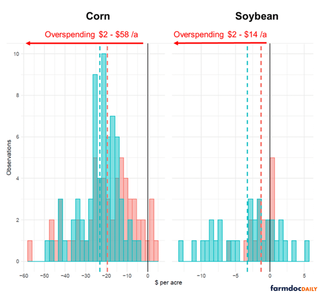
Grain nutrient concentrations can vary across the farm and may provide an opportunity to cut input costs this fall. Soil test values can vary due to sampling time and lab procedures; it may be worthwhile to monitor the variability of soil test values by sampling at different timepoints post-harvest and sending the same sample (labeled differently) to the lab before committing to a fertilization strategy this fall. Consider evaluating economic return to phosphorus (P) and potassium (K) applications, not just potential yield response this fall, whether that be via an unfertilized or reduced rate check strip, grain sampling for precise maintenance rates, or partial drawdown on applicable acres. Rethinking standard P and K management practices can provide a greater understanding of recommendations and improve economic returns.
New Report on Foreign Sugar Subsidies Released
Texas Tech University unveiled an update to its crucial 2019 report on foreign sugar subsidies, giving U.S. trade negotiators and lawmakers a valuable resource on the distorted global sugar market.
This study – authored by Dr. Darren Hudson, director of the school’s International Center for Agricultural Competitiveness, and Shawn Wade, assistant director – details the policies deployed by the world’s largest sugar producers to tilt the global playing field in their favor.
USDA Releases Quarterly Grain Stocks, Small Grains Summary Reports
The final quarterly stocks for the 2025-26 corn crop came in above analysts' expectations at 2.1 billion bushels, while soybean quarterly stocks came in at 315 million bushels, which was within the pre-report range.
USDA released its quarterly Grains Stocks and Small Grains Summary reports on Wednesday.

USDA details reorganization progress as legal challenge continues
USDA’s Deputy Secretary says the agency has made significant progress implementing its department-wide reorganization since the plan was announced this summer.
“We have hiring actions going on across this country as we are hiring new employees in our hubs to better serve the American farmer,” says Stephen Vaden.

Airbnb Announces ‘Farm to Stay’ Grant Program to Promote Farmer-Led Tourism
As economic pressure squeezes American farms and ranches, a new Airbnb report finds hosting on the platform earned the typical farm stay host close to $8,000 last year, with U.S. farms on Airbnb earning nearly $120 million in 2025. To help make this opportunity even more accessible, Airbnb and American Farmland Trust are announcing the ‘Farm to Stay’ Grant Program, which will offer farmers and ranchers up to $10,000 per grant to start or expand an agritourism stay or experience.

USDA Increases Investment in Regenerative Pilot Program to Lower Farmer Production Costs and Advance MAHA Agenda
The U.S. Department of Agriculture (USDA) announced increased financial assistance for the Regenerative Pilot Program from $700 million to $1 billion in fiscal year 2027, providing more producers with the opportunity to adopt conservation systems that improve soil health, water quality, and long-term farm resilience. Producers can now apply for assistance with regenerative practices.
Continuous improvement drives 2026 World Dairy Expo Producer of the Year
The 2026 World Dairy Expo Producers of the Year are always looking to improve.
Jonathan Lamb is a 12th-generation dairy farmer from Oakfield, New York. He says the family farm began in 1965 with just 65 cows and now spans 10,000 head and 15,000 acres across New York and Ohio.

Farmers, Others Sue USDA Over REAP Solar Restrictions, Funding Losses
Electricity prices and other energy costs keep rising, but USDA has severely restricted one of the biggest tools farmers and small rural businesses have had to produce solar power on their farms to offset costs, according to a new lawsuit.
Farmers in Iowa, Illinois and Wisconsin, along with solar energy groups, filed a lawsuit Monday in the U.S. District Court for the District of Columbia, suing USDA and department officials over changes to the Rural Energy for America Program (REAP) that plaintiffs argue were done to effectively block funding for nearly all on-farm solar projects.
.jpg?width=320)
Reducing food loss and waste to protect forests and transform agrifood systems
Reducing food loss and waste has transformative potential for agrifood systems, as saving food from being lost or wasted also saves nutrients, natural resources and money, while helping ease pressure on forests, the Director-General of the Food and Agriculture Organization of the United Nations (FAO), QU Dongyu, said today during a joint FAO-UN Environment Programme event held in observance of the seventh International Day of Awareness of Food Loss and Waste.
c151b854-7a66-4b4a-9918-30c803dc5199.jpg?width=320)
Why are migratory bird populations declining? OSU researchers seek answers
Migratory bird populations are declining: More than 50% of the world’s migratory bird species are in decline, with declines exceeding 60% in North America.
OSU researchers and their collaborators say that reversing population declines requires better monitoring, habitat protection, reduced threats, international cooperation and interdisciplinary research. People across the world can take practical steps to help.
USDA Crop Progress: Corn 18% Harvested, Soybeans 17% Harvested as of Sept. 27
After running ahead of normal the past few weeks, U.S. corn and soybean harvest progress slowed last week, bringing both crops back in line with the five-year average pace, according to USDA NASS's weekly Crop Progress report released Monday.
Disruptions to harvest activity and winter wheat seeding could continue this week, as heavy rainfall is forecast across the Central and Southern Plains.
.png?width=320)
EPA PFAS research investments target farmland, crops, and livestock
The Environmental Protection Agency recently awarded $15 million in research grants to study how PFAS, or forever chemicals, can move through crops and livestock.
Administrator Lee Zeldin tells Brownfield research and new technologies are rapidly evolving how the pollutants can be managed.

FTC, States Win Protections to Lower Pesticide Prices for American Farmers in Antitrust Case Against Corteva
The Federal Trade Commission and a coalition of state attorneys general have secured a significant settlement agreement with pesticide manufacturing giant Corteva Inc. that will lead to lower pesticide prices for American farmers.
Under the terms of the settlement, Corteva will dismantle its existing pesticides loyalty program, which has limited distributors’ ability to do business with generic competitors that seek to enter the market after Corteva patents have expired.
Grain markets await more Chinese purchases
A commodities economist says the grain markets are disappointed with the lack of immediate purchases from China as more details are unveiled from last week’s meeting.
“I think the markets had unrealistic expectations that we were going to immediately see orders on the books,” says Arlan Suderman.
ICE Enforcement Hampers Beef Packing in Kansas, Delaying Thousands of Cattle
Immigration and Customs Enforcement (ICE) activity disrupted major meatpacking communities in southwest Kansas this week, creating a "massive chilling effect" on workers who process beef, delaying the processing of thousands of fed cattle and "resulting in millions of dollars in lost revenue" for cattle producers, according to livestock groups.
.jpg?width=320)
Agri-Pulse Newsmakers: Sen. Hoeven, Economist Dan Basse and Krysta Harden on the farm bill timeline, the Trump-Xi meeting and the outlook for U.S. dairy.
Sen. John Hoeven says he thinks the farm bill will be passed in this lame duck session of Congress, Dan Basse of AgResource weighs in on the president’s meeting with Xi Jinping, and Krysta Harden of USDEC talks about the dairy industry.

Agriculture awaits details from U.S.-China trade talks
American Soybean Association President Scott Metzger says soybean farmers are looking for any positive news coming out of the U.S. and China trade meeting.
“Whether that’s a commitment to more bushels in the future, doing away with the tariffs or extending the Section 301 stuff with ship building.”
He tells Brownfield the two-month extension of a U.S. and China trade truce is positive, but he’d like to see more clarity on long-term soybean purchases and trade barriers.

A New Way to See Agricultural Bankruptcy Trends
Agricultural financial distress can be easy to see but difficult to quantify. Chapter 12 bankruptcy, specifically designed for family farmers and fishermen, has traditionally been used as the sole measurement of that stress in the legal system.
However, agricultural businesses who do not qualify for Chapter 12 may instead file under Chapter 11.

US Sept. 1 Hog Inventory Down 2% From Year Ago
United States inventory of all hogs and pigs on Sept. 1, 2026, was 74.3 million head. This was down 2% from Sept. 1, 2025, but up 2% from June 1, 2026, USDA NASS reported on Thursday.
.jpg?width=320)
Greenhouse gas benefits of ag irrigation outweigh emissions costs
Irrigating U.S. crops prevents higher greenhouse gas emissions by avoiding land conversion, groundbreaking new research by Colorado State University shows.
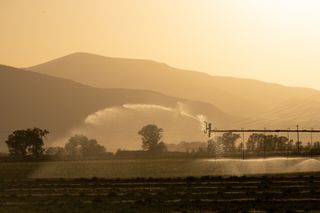
Agricultural irrigation allows the United States to grow more food on less land. If irrigation were suddenly shut off, the land change required to make up for lost yield would produce significantly more greenhouse gas emissions than those emitted by irrigating – 363 times more.
K-State economist sees diesel prices reaching $7 next year
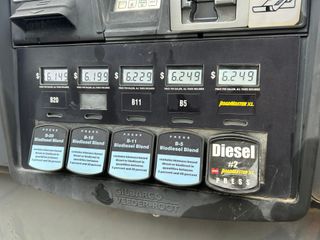
A Kansas State University ag economist projects diesel prices could hit $7 in 2027.
“Farmers are in a really, really bad situation here.”
Gregg Ibendahl says if global production and refinery issues were solved today, it would take an additional 12 months for major price improvement, and farmers are limited in their options.
Foreign Ownership of U.S. Agricultural Land
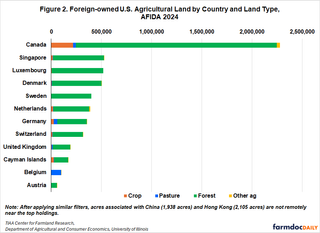
This article examines foreign ownership of US farmland and introduces an interactive mapping utility developed by the TIAA Center for Farmland Research that allows identification and delineation of foreign ownership by county, type, and use; along with the rankings of countries represented among the foreign ownership data.
EPA, HHS Reach Agreement to Expand Scientific Review of Glyphosate Health Risks
With an updated risk assessment of glyphosate expected to be completed early next year, the U.S. Environmental Protection Agency and the Department of Health and Human Services on Tuesday announced a plan to expand the volume of information available in making that evaluation.
.jpg?width=320)
Increased Beef Imports Have Not Lowered Prices For Consumers
Record imports along with the suspension of the tariff-rate quota for beef trimmings have not lowered ground beef prices for consumers. In fact, American Farm Bureau analysis reveals that since the presidential proclamation, prices remained the same as before the tariff-rate quota changed in 30 of 41 tracked grocery stores across the U.S.