News Archives
USDA continues implementation of reorganization
The deputy secretary with the USDA says the agency is well into implementing its announced reorganization plans.
Stephen Vaden says the goal of relocating several mission areas into five regional hubs is to improve cost savings and efficiency.

Fertilizer Prices Keep Sliding as UAN32 Leads 4 Nutrients in Significant Drops
Most retailer fertilizer prices continued their downward track in the third week of July for the seventh consecutive week, as five of the nutrients tracked by DTN were lower compared to the previous month.
.png?width=320)
Secretary Rollins Launches USDA Initiative to Recruit Veterans, Transitioning Service Members, and Military Spouses
U.S. Secretary of Agriculture Brooke L. Rollins announced a new U.S. Department of Agriculture (USDA) initiative to recruit veterans, transitioning service members, and military spouses into mission-critical careers that protect America’s food supply, strengthen rural communities, and defend the nation’s agricultural security.

The $30 Billion Problem: Farm Bill Funding Meets its Limit
Moving forward, if outlays related to the implementation of key farm bill income support and conservation programs are near the $30 billion cap, there would be limited financial resources available to respond to emergency needs, e.g., geopolitical disruptions or large-scale animal disease outbreaks.

Volatile fertilizer market could change how farmers buy inputs
An ag economist says he doesn’t expect improvement in fertilizer prices anytime soon, and it may impact how they purchase inputs for the 2027 crop.

NIFA Says It Learned From 2019 Relocation. Its Workers Aren't So Sure
USDA's planned relocation of the Economic Research Service (ERS) and National Institute of Food and Agriculture (NIFA) to Kansas City is prompting comparisons to the agencies' 2019 move -- one that resulted in a 75% loss of the relocated workforce and a lengthy hiring process.
.jpg?width=320)
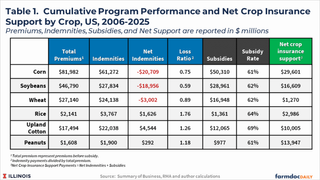
Crop Insurance Loss Performance and Impacts on Farmer Net Support by Crop
This article further evaluates the impact of the program’s longer-term performance on the net insurance support received by producers who use crop insurance and how that varies by crop and region.
Hot July brings pollination concerns
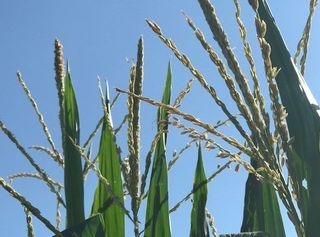
The chief atmospheric scientist with Nutrien Ag Solutions says most of the U.S. corn crop is pollinating in less-than-ideal conditions.
Eric Snodgrass says much of the Corn Belt saw high heat throughout the month of July.
July Cattle Report Signals Stabilizing Cattle Herd
U.S. cattle herd shows signs of stabilization. Total cattle inventory increased slightly for the first time since 2018, but the beef cow herd fell to 28.5 million head, a record low for the July report, indicating herd rebuilding remains limited.
USDA Crop Progress: Corn Rated 63% Good to Excellent; Soybeans 63% Good to Excellent as of July 26
Crop conditions weakened last week as good-to-excellent ratings for both corn and soybeans fell 3 percentage points, according to USDA NASS's weekly Crop Progress report released Monday.
.png?width=320)
USDA Reminds Agricultural Producers of Approaching Deadlines for Safety Net, Disaster Assistance, and County Committees
The U.S. Department of Agriculture (USDA) is reminding agricultural producers impacted by increased input costs and natural disasters that the deadlines to apply for safety net and disaster assistance programs designed to protect their financial security are coming soon. USDA’s Farm Service Agency (FSA) wants to remind producers that the Assistance for Specialty Crop Farmers (ASCF) program and the Supplemental Disaster Relief Program (SDRP), both have deadlines in early August.
USDA announces August reopening of Arizona port for cattle imports from Mexico
The USDA has announced plans to resume live cattle imports from Mexico. Beginning August 24th, the department says it will open the Douglas, Arizona port to cattle trade.
.jpg?width=320)
Cyclospora outbreak linked to iceberg lettuce expanded to four new states.
Since the last update on July 18, 2026, 4 states have been added to the multistate outbreak, and the total case count is now 1,947. The 4 additional states are Illinois, Kansas, Oklahoma, and Pennsylvania.
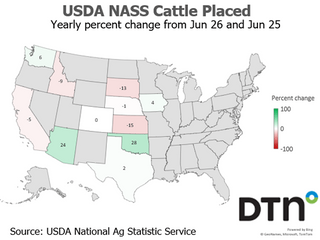
July 1 Cattle on Feed Up 2% From Year Ago; July 1 Cattle Inventory Up Slightly
Cattle and calves on feed for the slaughter market in the United States for feedlots with capacity of 1,000 or more head totaled 11.4 million head on July 1, 2026. The inventory was 2% above July 1, 2025, USDA NASS reported on Friday.
Agri-Pulse Newsmakers: Sen. Ben Ray Luján on farm bill, PIIE's Alan Wolff on tariffs & trade
Senate Agriculture Committee Chair John Boozman says he plans to have a markup this summer on his version of the farm bill. New Mexico Senator Ben Ray Luján joins Newsmakers to discuss his thoughts on the bill and changes he'd like to see in the markup.
ASA Appreciates Agricultural Input Exemptions, Calls for More
The Trump Administration has announced new Section 301 tariffs on imports from 60 trading partners, replacing the expired Section 122 tariffs. The new action includes exemptions for certain agricultural inputs, including some products the American Soybean Association and a broad coalition of agricultural organizations identified as critical to U.S. farmers.
.jpg?width=320)
House GOP Passes $95B Budget Resolution With $12B in Farm Aid; Some Farm Groups Oppose War Funding
The House of Representatives passed a $95 billion budget resolution Wednesday along party lines that would direct up to $12 billion in aid to struggling farmers while providing $73 billion for defense and intelligence spending tied to the ongoing war with Iran.
.jpg?width=320)
USTR Recommends ITC Investigation into Lamb Imports Following ASI's Safeguard Request
The American Sheep Industry Association welcomed the decision by the Office of the U.S. Trade Representative (USTR) to recommend that the U.S. International Trade Commission (ITC) initiate a global safeguard investigation into imports of lamb meat under Sections 201 and 202 of the Trade Act of 1974.
The cost of banning glyphosate
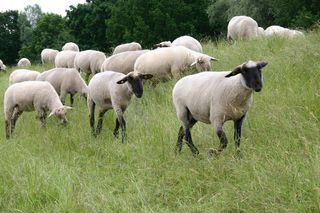
A professor of weed science at the University of Illinois says a new analysis finds the economic cost of a glyphosate ban would be monumental.
Aaron Hager says the research done in conjunction with the Illinois Soybean Association shows Illinois farmers alone would lose up to $600 million every year

Could this Cattle Inventory Report Signal Initiation of a New Cattle Cycle?
The USDA’s mid-year cattle inventory report will be released this Friday, July 24, 2026, with many anticipating still lower inventories as drought conditions across much of cattle country could lead to culling of cows and feeding out instead of retaining heifers.
USDA Asks Partners to Develop AI Solutions to Accelerate Crop Innovation
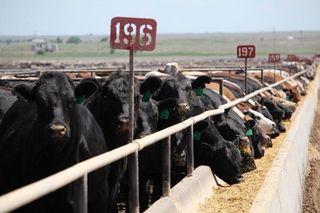
The U.S. Department of Agriculture (USDA) is taking steps to speed up progress in plant science by calling on universities and stakeholders to help build new AI tools that can translate the huge amount of germplasm data the agency collects.
Fertilizer Prices Continue Downward Trend
Retail fertilizer prices tracked by DTN for the second full week of July 2026 continue to fall compared to last month. Mostly lower prices have been present for six straight weeks now, according to DTN price data.
.png?width=320)
Corn growers push for faster probe into fertilizer industry
Several state corn growers associations have asked the Senate Judiciary Committee to expedite an investigation into the U.S fertilizer industry.
Vice President of the Kansas group Brett Grauerholz says he’d like the findings to identify what’s driving record-high prices, but, “This is not going to be a quick easy fix as much as we want it."
FFAR Rapid Funding Explores Genetic Immunity to Avian Influenza
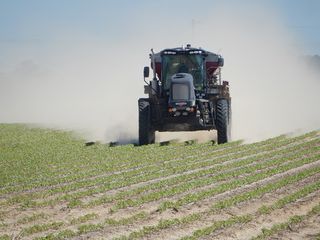
Highly pathogenic avian influenza (HPAI) continues to threaten the U.S. poultry industry, causing billions of dollars in economic losses while disrupting food production and increasing costs for farmers and consumers. The Foundation for Food & Agriculture Research (FFAR), Iowa State University, and the Commonwealth Scientific and Industrial Research Organisation (CSIRO) are investing $300,000 through the Rapid Outcomes from Agricultural Research (ROAR) program to identify genetic factors in birds that are relevant in the host response against H5N1 and H7N9 avian influenza viruses.
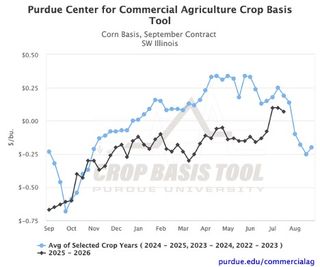
July Crop Basis Update: Strengthening Continues, But Seasonal Decreases Loom
Since the third week of June, corn basis relative to September futures and soybean basis relative to August futures have generally strengthened across the Eastern Corn Belt. Indiana and Ohio continue to set the benchmark for corn basis, while soybean basis strength is more dispersed. Iowa remains the weakest for both crops.
Heat Wave Worsens Cattle Pasture Conditions Across the Plains
Last week's heat wave impacted pasture and range conditions causing a movement in the less ideal side throughout beef cow states of the upper Midwest and Plains
A decrease was seen in the states of Minnesota, Iowa, Nebraska, South Dakota, North Dakota and Montana in the good-to-excellent category.
.png?width=320)
U.S. Senate Appropriations Committee considers USDA’s $11.1 billion emergency farm aid request
Ag Secretary Brooke Rollins says the supplemental funding bill under consideration by the U.S. Senate would provide farmers $11.1 billion in emergency relief.
“It buys the nation the security that we need, and it buys us time to deconstruct and then reconstruct a new system, putting our farmers and ranchers first,” she says.

USDA Crop Progress: Corn Rated 67% Good to Excellent; Soybeans 66% Good to Excellent as of July 19
Soybean condition ratings improved for a second straight week, while U.S. corn conditions slipped, according to USDA NASS's weekly Crop Progress report released Monday.
.png?width=320)